How often should you get NAD+ therapy? It is the most common question people ask about it, and the one the internet answers worst. Search for a schedule and you will find confident weekly plans, “loading phases” and dosage charts published by people who have never examined you. Here is the honest answer: there is no established, evidence-based schedule for NAD+ therapy, and frequency is a medical decision made by a physician after evaluating you individually.
PassQual Health does offer NAD+ therapy and IV infusion services in Miami Gardens. This article explains how frequency is actually decided, what influences it, and why following a chart you found online is a bad idea.
Why no standard NAD+ schedule exists
Dosing schedules for approved medications come from clinical trials and appear in FDA-approved labeling. NAD+ has no such labeling for these uses. In the United States the NAD+ used in injections and infusions is a compounded preparation, and the FDA is clear that compounded drugs are not FDA-approved: the agency does not verify their safety or effectiveness, and they lack an FDA finding of manufacturing quality before reaching patients.
What that means practically is that the schedules you see advertised are clinic conventions, not validated protocols. They vary widely between providers, which is itself a signal: if the correct interval were known, it would not differ this much from one website to the next.
Why we do not publish a dosing chart
We are asked for one regularly, and we decline for the same reason we would decline to publish an antibiotic chart. A chart implies the number is determined by a category — your age, your goal, a package tier — when in reality it depends on your health, your medications and how you respond to a first session under supervision. Publishing a chart would also invite people to self-administer, which is where real harm happens.
A physician can tell you what is reasonable for you. A web page cannot, and any page that claims to is selling something.
What a physician actually weighs
- Your medical history, including conditions that make infusion therapy inadvisable
- Current medications and supplements, and possible interactions
- Route — intramuscular injections and intravenous infusions are handled differently
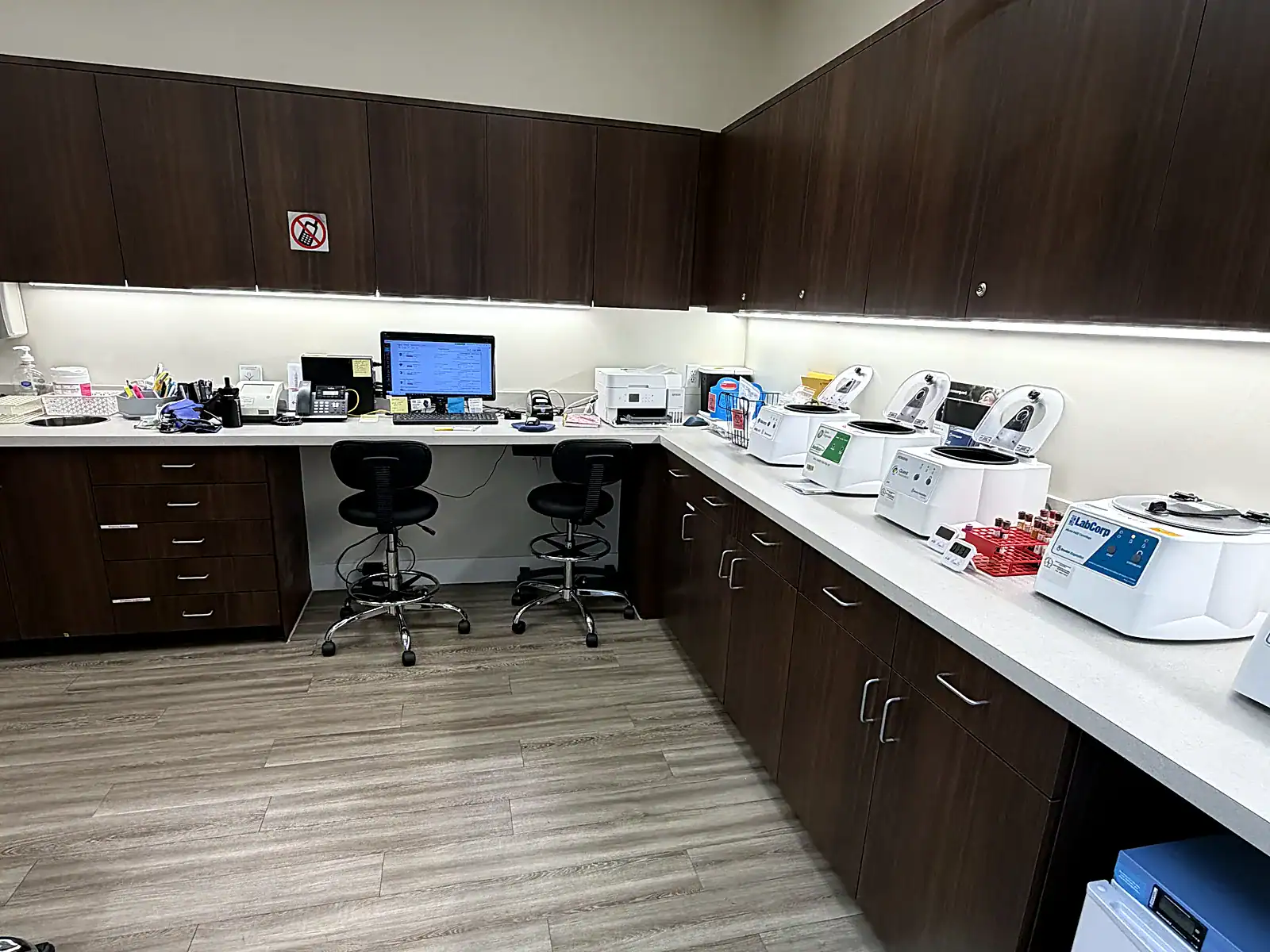
- Relevant laboratory findings, drawn at our on-site medical laboratory when the physician considers testing appropriate
- How you tolerated any previous session, including infusion rate and side effects
- Pregnancy, breastfeeding, or plans to become pregnant
- Whether NAD+ therapy is appropriate for you at all — sometimes it is not
Note what is absent from that list: what a competitor’s package says, and what you read on social media.
Why sessions run slowly
People are often surprised that an NAD+ IV infusion takes an hour or more. That is deliberate, and the reason is tolerability. A small retrospective pilot study published in Frontiers in Aging in 2026 reported that all six clients receiving IV NAD+ experienced side effects during infusion, including abdominal cramping, nausea, increased heart rate and chest pressure. Slowing the rate is the standard clinical response. Rate and duration are part of what “how often” really means, and both are decided in the room by the clinician monitoring you — not in advance by a chart.
Why self-directed dosing is unsafe
Vials, “research” kits and pre-filled syringes are sold online with instructions attached. Injecting them yourself carries risks a schedule cannot manage:
- Product quality. Material bought online may not be sterile, correctly labeled or accurately concentrated. FDA warns that poor compounding practices can lead to contamination or too much active ingredient.
- No screening. Nobody has reviewed whether your medications or medical conditions make this a bad idea.
- No supervision. If you react during administration, there is no clinician present.
- No follow-up. Frequency should be revisited over time, not fixed on day one.
How frequency is revisited at PassQual Health
NAD+ therapy here is administered under physician supervision after a medical evaluation, and any interval discussed at that first visit is provisional. Your physician reassesses at follow-up — how you tolerated the session, what changed in your health or medications, whether continuing is reasonable at all. Discontinuing is a legitimate outcome, and we will say so.
Individual responses vary, and NAD+ therapy is not FDA-approved for the uses it is commonly marketed for. We do not promise outcomes and we do not sell frequency in advance of an evaluation. More detail is on our NAD+ therapy and IV infusion page, and if you want the underlying science, read what NAD+ injections are and what the research does and does not show. New patients may also find what to expect at a first visit useful.
Sources
- FDA — Understanding the Risks of Compounded Drugs
- FDA — Certain Bulk Drug Substances for Use in Compounding That May Present Significant Safety Risks
- NIH Office of Dietary Supplements — Niacin: Fact Sheet for Health Professionals
- Frontiers in Aging (2026) — Intravenous infusion of NAD+ versus nicotinamide riboside: a retrospective tolerability pilot study
Talk to a physician first
This article is educational and is not medical advice. It is not a recommendation to receive NAD+ therapy, does not describe treatment for any disease or condition, and does not provide dosing guidance. Consult a physician about your own health before starting or changing any therapy. To arrange an evaluation in English or Spanish, call PassQual Health at 786-677-9922 or book an appointment.